The problem with CPQ
CPQ has a reputation of being slow, brittle and hard to configure, and of needing customization for anything non-standard. You need a specialist or a team of specialists to implement and maintain the tool. The usual diagnosis is that it's too complicated.
We think it's the opposite. The problem isn’t that CPQ does too much. It’s that it does too little, so your team builds the rest.
We built Roadrunner the other way around. The parts teams usually build by hand, like complex ramps, many-to-many swaps, amendments and early renewals, are in the product, and you can still customize whatever makes your business unique.
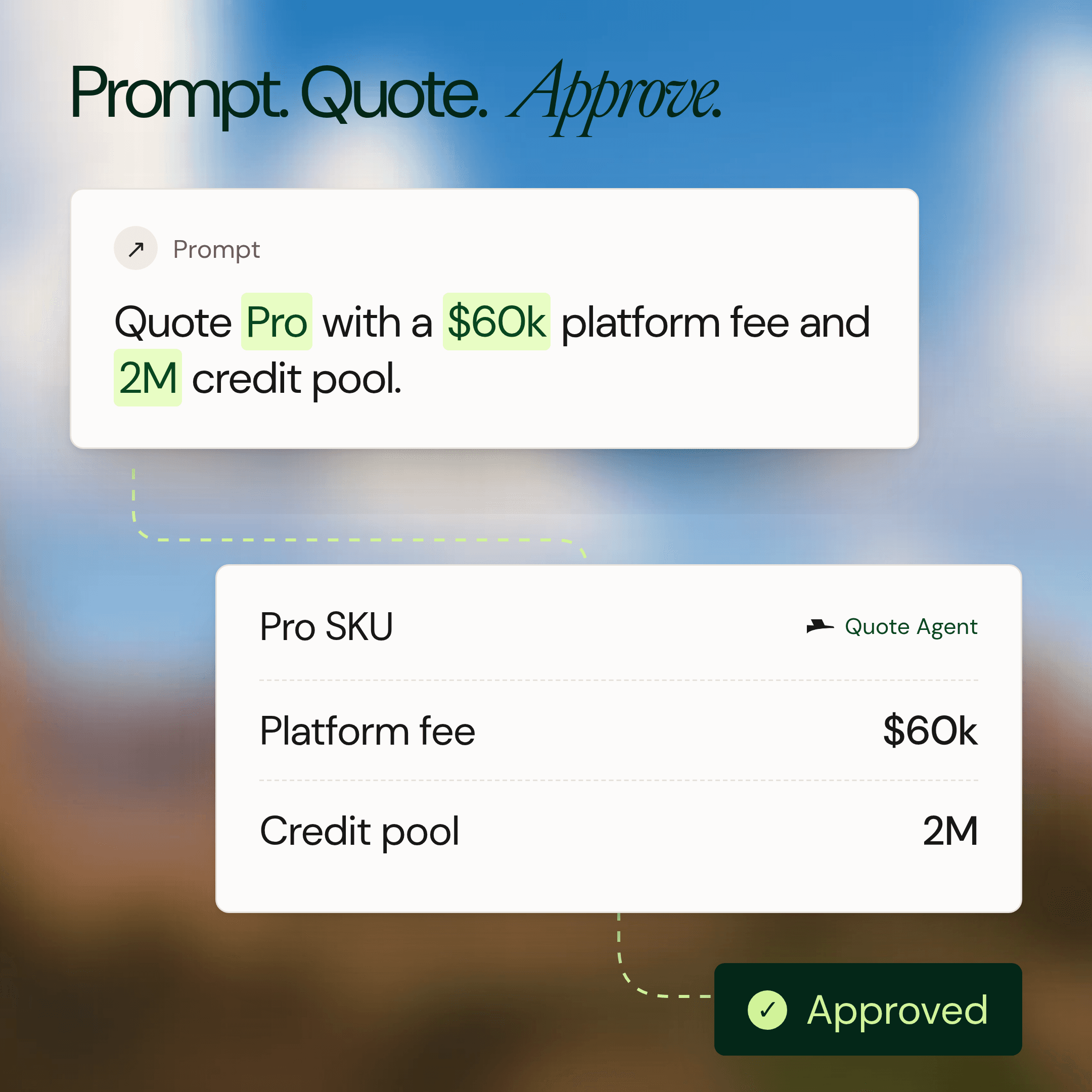
That's why we call it the most advanced CPQ in the world, even though we don't think of it as a CPQ at all. CPQ is named for the work it makes your team do: configure, price, quote. Roadrunner is a PQA, named for how quoting works when the system does the configuring:
- Prompt. The rep describes the deal, in plain words to the agent or step by step on the quote.
- Quote. Roadrunner builds and prices it, however complex it gets.
- Approve. Your policy decides who signs off, and the quote goes to them.
That's a big claim. The rest of this post backs it up: why most teams end up building their own CPQ, the model that makes that unnecessary, and nine examples of it at work.
You've already built your own CPQ
If you run RevOps or Deal Desk, you know enterprise revenue never sits still. Every company sells a little differently, and almost none will change how they sell to fit a tool.
It starts simple: a few products and a price book. Then you launch usage pricing. Then a bundle that ramps. Then a customer who wants to renew early. Every time how you sell changes, your team builds what's missing: a custom field here, a trigger there, a consultant's script for the one after that.
Each fix makes sense on its own, but two years later you have a CPQ inside your CPQ, and the only people who understand it are the ones who built it.
With Roadrunner, when you change how you sell, you change your setup, not your custom code. Build on top when you want to, not because you have to.
Built for every quote after the first
Most CPQs are built to get the first quote out the door. The hard part is every quote after it: the added seats, the swap, the early renewal. Each one has to start from what the customer already owns.
So Roadrunner follows a deal through four layers, and each one is a snapshot of the one before it:
- Catalog: what you sell and how it's priced.
- Quote: the deal being negotiated.
- Order: what the customer signed, frozen.
- Asset: what the customer owns today, and every change that got them there.
So every quote after the first starts from what the customer actually has: what they bought, what they pay for it, and every change since. The nine sections below put that model to work, from setting up what you sell to a renewal that changes five things at once.
1. Catalog: one product, every way you charge for it
Imagine you sell the following together as part of your Pro SKU:
- $60k platform fee
- An optional annual commit which discounts the platform fee, the higher it goes
- Every call to your API should charge an overage based on a tiered rate card
- 2M credit pool across your platform
When your company was tiny, the Pro SKU was just a simple $60k platform fee. But over the quarters, your team iterated on pricing dozens of times.
- You tried a platform fee + an annual commit.
- You also tried a platform fee + the API overage charge.
- You even tried all three, and now you've settled at four things together.
- And for customers who pay monthly, you sell just the platform fee and the API overage.
Is that one product or many? In most CPQs, every one of those is its own product, so you end up with dozens of Pro SKUs, each with its own customers.
Which one does the rep quote? The rep has to know which version each customer belongs on, and at renewal, which one to move them to.
In Roadrunner, one product covers every way you charge for it. Annual or monthly, Pro is the same thing, just charged differently. The catalog has three layers:
- The Product is what is sold
- The Plan is one way the product is being charged (a product can have multiple plans)
- Pricing Methods actually compose the price of the product (a plan can have multiple pricing methods)
The next time you change pricing, you add a plan, not a product. You define each attribute once and reuse it across your catalog, and each slice of a deal keeps its own answers, so they can change partway through a contract. The next section shows how.
2. Bundles: ramps that keep themselves in step
A customer wants a three-year ramp. 100 seats of Pro in year one, 250 in year two, 500 in year three, sold as a bundle with support, analytics, SSO and onboarding.
How does support keep up? It has to stay at one seat for every 10 Pro seats. Change year two to 300, and support should move to 30 without anyone touching it.
What if a child has its own schedule? Analytics runs 50 seats for the first 18 months while the customer gets set up, then 200, a step that doesn't line up with Pro's years. SSO starts in month 5. Onboarding is charged once, up front.
Does SSO cost extra? Your rule: included when Pro is billed annually, full price when it's monthly.
What about year three? The customer's headquarters move to the EU, so year three needs the GDPR-compliant version of Pro.
Without this in the product, each year is its own line, a trigger recalculates support every time Pro changes, and the EU year becomes a different product.
In Roadrunner, a ramped bundle stays one line per product, and each child keeps itself in step. A quote line is cut into segments: slices of time, each with its own quantity, attributes and price. A ramp is one line with three segments, and year three can be in the EU without a new product.
Bundles are relationships between products, and each one carries its own rules. A child can follow the parent's ramp and scale with it, like support, or keep its own schedule, like analytics and SSO. A rule can also depend on the plan, which is how SSO comes included on Pro Annual. Those rules are copied onto the customer's assets at booking, so a catalog change next year doesn't rewrite a deal already sold.
3. Amendments: upsells that price themselves
A customer is partway through their contract and wants to add seats. They're 14 months into a three-year contract with 250 seats of Pro, and they want 150 more starting next month.
What do the new seats cost? The customer pays $40 a seat, but Pro's list price has since gone up to $50. Your pricing rule decides which one applies, once, for every deal like this.
Does the volume discount kick in? Pro gets cheaper at 300 seats. This order is only 150, but the customer will have 400. Your price rule decides what counts: the 150 on this order, or all 400 the customer will have. Count all 400 and the discount applies, at the rates you set.
What happens to the success plan? The customer also pays for a success plan: onboarding and support, priced at 20% of their Pro spend. It should go up for all 400 seats, not just the new 150, and it does, without anyone touching its line.
No other CPQ can answer all three of these out of the box. What that means for your team: custom fields that remember what each customer bought, a script that does the math, and Deal Desk checking the result by hand. When the script gets one wrong, the customer gets a wrong invoice.
In Roadrunner, a mid-term upsell is priced from what the customer already owns. The rep adds 150 seats, and the price, the discount and the success plan are worked out for them.
4. Swaps: repackage your catalog, keep every customer's history
A one-for-one swap is the easy case. When a customer moves from Pro to Enterprise, Roadrunner ends Pro, credits the rest of its term at the price the customer paid, and starts Enterprise as a new asset. A swap link keeps the history as one upgrade, not a cancellation and a new sale.
The hard swaps come when you change your packaging. Say you retire four products Core, Reporting, Insights and Connectors and replace them with two: Suite and Integration Pack. Every customer on the old products has to land on the new ones at renewal, with the right quantities, and without the change showing up as churn.
In Roadrunner, you describe that change once, as a swap rule in the catalog. The Pro-to-Enterprise swap above is a swap rule too, the simplest kind: one product in, one out. Every swap rule answers the same three questions:
| The rule answers | In this example |
|---|---|
| What gets replaced? Old products, plans or categories, narrowed by a condition when needed | Core and Insights, Reporting only when it's inside a Core bundle, and Connectors |
| What replaces it? One new product, or several | Suite for the seats, Integration Pack for the Connectors |
| How are the new lines filled in? Formulas for quantity, attributes or any custom field you track | Suite seats = Core + Insights seats. Packs = Connectors ÷ 5, rounded up. |
You also choose when a rule applies: mid-contract, at renewal, or both.
When a customer renews, Roadrunner checks what they own against your swap rules and applies the ones that match. Here's a customer renewing next month:
| The customer has | At renewal |
|---|---|
| Core, 200 seats, with Reporting inside | Suite, 350 seats |
| Insights, 150 seats | Folded into Suite |
| 12 Connectors | 3 Integration Packs |
| 1 Reporting license on its own | 1 Reporting license: no rule matches it, so it renews as it is |
Because Roadrunner links each new line to the lines it replaced, your ARR formulas can count this as a repackage, not four cancellations and two new sales.
Without this in the product, it's a spreadsheet. For every renewing customer, someone works out which old lines become which new ones, cancels four, adds two, redoes the quantities and tags the deal so it doesn't count as churn.
In Roadrunner, a repackage is one swap rule in the catalog. You write it once, every renewal follows it, and every customer keeps their history.
5. Renewals: renew early, without billing twice
A customer wants to grow, and commit for longer. They're in month 30 of a three-year contract with 400 seats at $40. They'd like 600 seats, and they'll sign for three more years if the price drops to $36 a seat. You agree, as long as the new term starts today. Waiting six months for their renewal date isn't the deal either side wants.
What happens to the last six months? The new term starts before the old one ends, so for six months the two overlap. Something has to end the old term early, or the customer pays twice for the same seats. Roadrunner ends it the day before the renewal starts, on the same quote. The rep doesn't add that step; the engine does.
How much do they get back? The six months they won't use, credited at the $40 they actually paid, not today's list price. Roadrunner always credits what was paid.
What does the new term cost? $36 a seat for all 600 seats. Your pricing rule sets the starting price, and the rep's discount for the longer commitment goes on top.
What if they're switching products too? If the early renewal is also a swap, like the ones in section 4, the old product closes out on its own line and the new one starts fresh. Still one quote.
Without this in the product, it's a custom flow to cancel the rest of the term, a credit memo someone works out by hand, and a ticket to billing so nothing bills twice.
In Roadrunner, an early renewal is one quote. The rep sets the start date, the term, the seats and the price, and Roadrunner ends the old term, credits the unused months at the price paid, and starts the new one.
6. Billing: the quote and the invoice agree
A customer adds seats partway through the year. Their contract runs January 1 to December 31 at $1,200 per seat per year, and on February 15 they add 10 seats.
How do you count part of a year? There's more than one right answer:
All four are correct. Your contract decides which one is yours.
Where does the count start? From February 15, when the seats were added, or from January 1, when the contract began? Move the start, and most of these numbers change again.
How often is it billed? The seats are priced per year, but this customer pays quarterly. So the invoice isn't one number for the rest of the year. It's a partial first quarter, then three full ones, and that first quarter has to be counted the same way the quote counted it.
Does it hold up next time? The quote is one moment. The next amendment, and the invoice, have to count the same way, or they drift from what the customer signed.
Without this in the product, the quote picks one answer and billing often picks another. The usual fix is a finance analyst who checks every quote against every invoice, and a credit memo for whatever slips through.
In Roadrunner, the quote, the order and what goes to billing all count partial periods the same way. You answer each question once, in the catalog: how to count (seven proration methods, from exact days to whole terms), how often each line is billed (separately from how it's priced), and where billing periods start (the contract's start or the charge's). Once the deal is booked, the order and the asset keep all three, so the next change counts the way the quote did, and what you send to billing matches it.
7. Approvals: every sign-off routed, none repeated
A quote needs three sign-offs. A rep builds a quote at 32% off with 90-day payment terms. Sales has to approve the discount, Finance has to approve the discount and the terms, and Legal has to approve the terms.
Who approves, and in what order? Your approval rules read the quote and build its path: Sales first, then Finance and Legal side by side, since they're checking different things. The rep sees the whole path before they submit.
What counts as Finance saying yes? Finance wants two of its three people to agree. Each step sets how many have to approve: an exact number, a majority, or everyone.
Who exactly gets the approval request? Approvers are found for each deal: a group, a named person, the rep's manager, or someone further up the org chart.
What happens when the deal changes? Finance pushes back and asks for 28% instead of 32%. The rep makes the change. Roadrunner's approvals remember what each sign-off was based on, and you choose which changes send it back: any change, only an increase, only a decrease, or none. A lower discount only makes the deal better for you, so Sales' approval stands and the quote picks up where it left off.
Without this in the product, approvals run one step at a time. Legal waits for Finance, the rep only finds out who's involved after submitting, and any edit, even one that makes the deal better for you, starts the chain over.
In Roadrunner, every quote builds its own approval path from rules Deal Desk sets up once. The same rules can tell new business from a renewal and check what the customer already owns.
8. Customization: build what's yours, not what's missing
Every company has something nobody else does. Finance counts ARR its own way. Prices for Europe come from a separate price list. Reps selling there have to answer three questions before they quote. And when a deal books, your team wants a few extra steps of its own.
What's the same at every company is built in: pricing, product rules, approvals, and how every change is tracked. The rest is yours, and Roadrunner gives you four building blocks to define it:
| Building block | What it's for | In this example |
|---|---|---|
| Formulas | Any rule you can state, written in CEL (an open expression language) | ARR. One company counts one-time fees and annualizes a six-month segment; the next does neither. |
| Custom fields | Anything you track that we don't | The data-residency region on each quote |
| Custom tables | Your own reference data | The European price list, read by a formula when a line is priced |
| Workflows | Screens, steps and automation | The three guided-selling questions, opened from a button on the quote, plus your own steps when a deal books |
In Roadrunner, what's unique to your business is built from these four blocks and runs next to everything that's built in, and you can test it before it goes live.
9. All of it: five changes, one quote
A renewal conversation rarely changes just one thing. Take a growing customer in month 30 of a three-year contract. On one call, they ask for all of this:
| Line | What the customer wants | Kind of change |
|---|---|---|
| Pro | Grow from 500 to 550 seats on a new three-year term starting next month | Early renewal |
| Analytics | Move to Analytics Plus on the new term | Early renewal swap |
| Sandboxes | 2 more, starting now, for the rest of this term | Amendment |
| Legacy Support | Let it run out, and don't renew it | Not renewed |
| AI Assistant | Start today | New sale |
Every change from the sections above, on one quote.
Usually, that's at least three quotes: an amendment, a renewal and a new deal. Each gets its own approval, none of them can see the others, and Deal Desk checks by hand that nothing bills twice.
In Roadrunner, an early renewal, a swap, an amendment and a new sale for one customer all can go on one quote. Each line already says what kind of change it is, so the engine does what the earlier sections showed, all at once. It ends Pro and Analytics the day before the new term starts and credits the overlap at the price paid. It starts Analytics Plus with a swap link back to Analytics. It adds the sandboxes for the rest of this term, and it lets Legacy Support run out.
Prompt. Quote. Approve.
None of this is exotic. Ramps, swaps, early renewals, a renewal call that changes five things at once: this is how enterprise software is sold now. Most teams still handle it by hand, and you already know where those hours go.
With Roadrunner, the hard parts are built in. Your reps describe the deal, Roadrunner gets the quote right, and Deal Desk spends its time on the calls that need judgment, not on checking the math. That's a PQA.